
Krull is the 80s distilled.*1 You can't have forgotten Krull.
Yeah, man... let's talk about the video game adaptation of the movie Krull. Remember Krull? No? Let me help you out and refresh your memory a little, okay?
Directed by Peter Yates, a filmmaker who had already helmed productions like Bullitt (1968), the film had a hefty budget, elaborate sets and epic ambition. The story was that of a prince, Colwyn, who had to rescue Princess Lyssa from the clutches of a creature known simply as "the Beast", lord of a moving fortress that changed places every dawn.
This article is also available as a video on "Pior Canal do Mundo"*2 — in Portuguese.
Watch the video (PT-BR)
The plot mixed medieval elements — kings, swords, battles — with science fiction ingredients, like spaceships and alien monsters. For many critics, that hybrid was confusing, but for the young audience of the time, that very excess was the charm.
In Brazil, this film was a classic of the Sessão da Tarde,*3 with its space plot on a planet that resembles Earth in the Middle Ages and is attacked by a colonizing interplanetary beast. In Krull, the villain conquers worlds easily thanks to superior technology and strength. To defend their lives, the planet's two main kingdoms decide to become one family through a marriage between the royal houses, and the rest of the story takes shape after the bride is kidnapped.
From flop to cult
Well... the film flopped financially, but it won something money couldn't buy: a cult aura. Over the decades, Krull was remembered as a strange, bold work that didn't seem to fit any defined mold. And maybe that's exactly why it was chosen to cross over into other media.
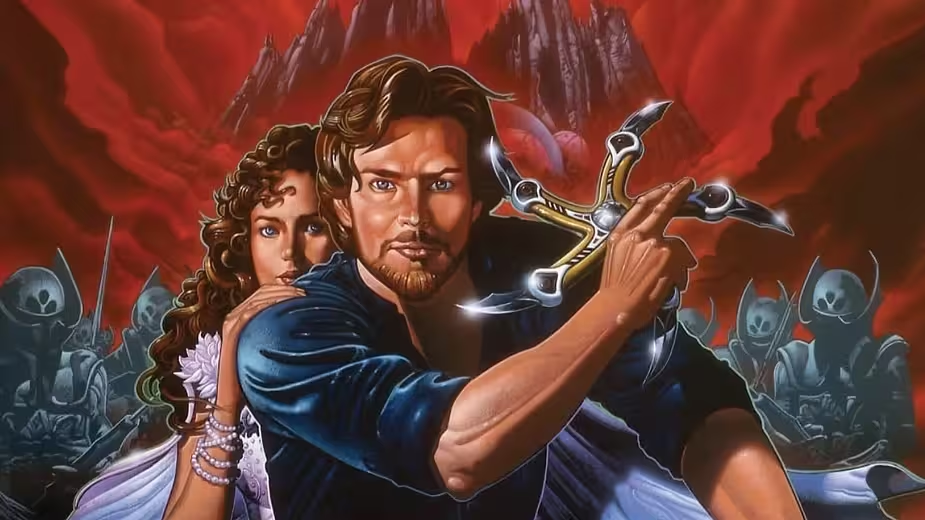
In a world where almost any movie got a video game adaptation, it was natural for Krull to end up in arcades, planned pinball machines and, above all, on the Atari 2600 — the console that, despite its limitations, reigned supreme in homes. In Brazil that throne came with a twist: the official Atari only arrived in October 1983, and before that a good part of the consoles in Brazilian living rooms were smuggled units or local clones.*4
Video games: Krull in the arcade and on pinball
The arcade game and the pinball were born at Gottlieb, the company founded by David Gottlieb, one of the guys who practically invented the concept of coin-operated electronic entertainment and helped popularize flippers. That's where the word "fliperama" comes from, after all — it's what arcades are called in much of Brazil.*5
The Krull pinball is a gem: a gorgeous machine, full of details inspired by the film. On the inner panel, in the background, you'll find the final battle inside the Beast's Fortress. It was a way of carrying the film's mythology onto a game table.
Its production for commercial distribution ended up canceled because it was considered too expensive, so anyone who ran into one of these machines was standing before a rarity — and the few tables that still exist are in the hands of collectors, who treat them like true museum pieces.
But well... Gottlieb itself, besides being a pinball giant, also left its mark on video games, releasing titles that, though not always remembered, were incredibly creative and full of sound, like the challenging Reactor, the intense Mad Planets and, of course, the legendary Q*bert. The latter became a pop culture icon — a pioneering gaming mascot with huge commercial appeal. And almost all of them, one way or another, ended up making Atari 2600 owners happy too.
But still on the subject of arcades, the Krull game released in 1983 is truly respectable for its time. It had its own sound style, a striking visual identity and an eye-catching cabinet, the kind that drew kids in just with the racket.
The gameplay used two joysticks: one to move the character, another to throw the Glaive (in Brazil, the "Gládio"*6) in the desired direction. It was a different solution that gave the game personality. On top of that, scenes from the film were spread across the stages, the sounds echoed the original production, and the physics of elements like rolling boulders made the experience more immersive than you'd expect for that year.
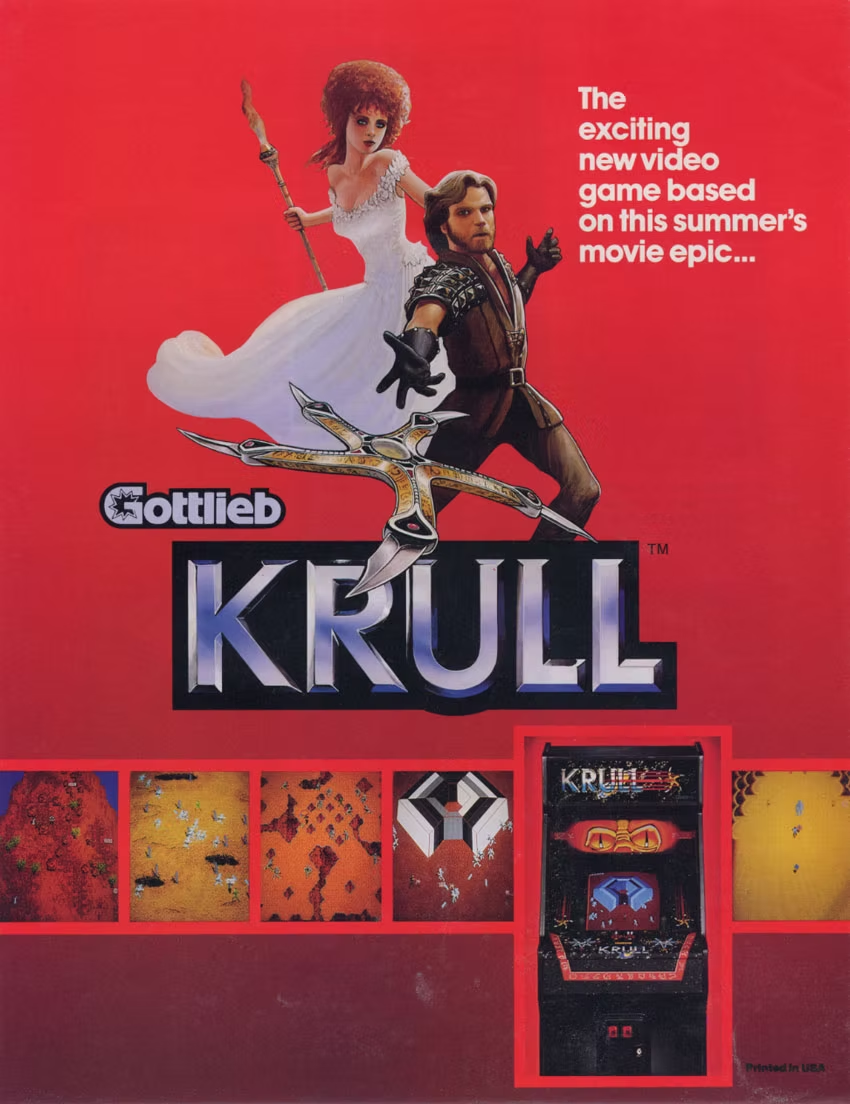
It wasn't perfect. The gameplay wasn't the most refined, and the great interplanetary Beast, monumental on the big screen, showed up in the arcade at just three times the hero's size — and that was a letdown.
Sure, in 1983 you couldn't expect colossal sprites, but you could dream of some creative solution, like the magic trick of fooling us by making the scenery itself the boss — a creative detail that Adventure (1979) pulled off on the Atari 2600 almost half a decade earlier... turning limitations into genius.
That's why, if I ask whether you remember Adventure, the answer is immediate. Krull, on the other hand, even with some effort, ended up more forgotten.
Krull on the Atari 2600
But then we get to the Atari 2600 version. That one is the cherry on top.
Krull on the home console is one of the most complete and distinctive games in the Atari library. Despite the technical gulf between a home console and the arcade machine, the 2600 game held its own. Quite the opposite: it delivered a varied and exciting experience, all with a single button.
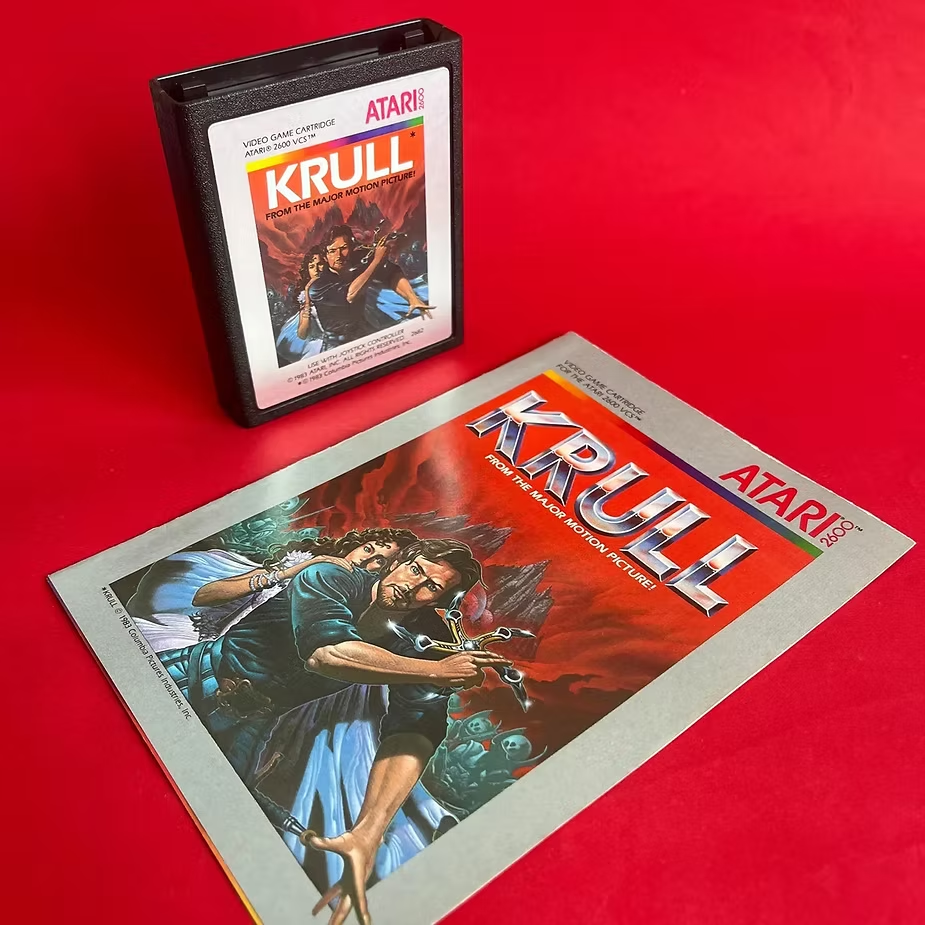
Also released the same year as the film, the game was programmed by Dave Staugas, who pulled off the improbable: squeezing an epic of fantasy and science fiction into an 8-kilobyte cartridge.
For many players, it was the first time they felt part of an epic story, even through a small television, amid the hiss of broadcast TV and the street noise coming in through the window. In Brazil, often on a black-and-white TV.
For those who played Krull back then, the memory goes beyond the cartridge. There was the ritual of switching on the console, setting the TV's channel selector, hearing that characteristic click and waiting for the title screen to show up. It was an initiation rite, in which the room turned into a movie theater and imagination filled in the gaps the graphics couldn't.
With each stage, the gameplay changed. The same button could throw the Glaive, swing the sword or jump, depending on the screen. The controls responded great, something rare by Atari standards. Almost every important scene was there: the interrupted wedding, the Widow of the Web, the horseback journeys, the final battle against the Beast.
The sound stood out too. Instead of repetitive music, the game favored immersive sound effects — especially in the horseback scenes, when the player crossed the planet on long journeys.
Why still talk about Krull?
So here, in the end, we have the adaptation of a film less remembered than it deserves, which is also a game less remembered than it deserves — one of the best on the old Atari; one look is enough to notice how smooth it is.
Today, looking back, everything around Krull reminds us of a time when fantasy needed no justification, when a kid could cross deserts on flaming horses with nothing but a joystick in hand.
What many people today see as cinematic trash made a generation of kids who still played in the street improvise their own magic star out of pieces of pipe, sticks or whatever they could get their hands on.
It's proof that even forgotten works find a place in people's lives. The past doesn't fade away: it keeps flickering on the screen, in limited colors, but intense enough to cross decades.
And this is Krull... nothing more, nothing less.
If you can't understand what I'm trying to explain, there isn't much more to be said...
Everybody dreamed of having that "Gládio".
Notes for readers outside Brazil
- *1In the Portuguese original: "o puro suco dos anos 80" — literally "the pure juice of the 80s", Brazilian slang for something that is the very essence of an era.
- *2"Pior Canal do Mundo" means "The Worst Channel in the World" — a self-deprecating joke. It's my YouTube channel, in Portuguese.
- *3Sessão da Tarde ("Afternoon Session") is TV Globo's weekday afternoon movie slot, on the air since 1974. Mostly comedies and adventures, rerun so many times that a whole generation of Brazilians knows the same films by heart — Krull among them.
- *4From the late 1970s on, Brazil kept a "market reserve" policy that restricted imports of computers and electronics. Local companies made their own unlicensed Atari clones (Dynavision, Dactari and others), and the officially licensed console only arrived in October 1983, through Gradiente's Polyvox brand.
- *5The word comes from "flipper", and in Brazil it ended up naming any arcade — both the place and the machines.
- *6The Glaive, the five-pointed throwing weapon from the film, was known in Brazil as "Gládio". Kids made their own out of whatever they found, as you'll read at the end.
Sources

Marcio Baião
I make stuff about retro games, anime and old horror flicks | Sometimes a scriptwriter, personal trainer and psychoanalyst (limited availability).
I only recommend products I bought myself and liked. Someone who paid for a product has a different experience from someone who got it from the brand to promote it. That is my conviction.
My picks (in Portuguese)

Comments